
by Lance Lunsford
Share
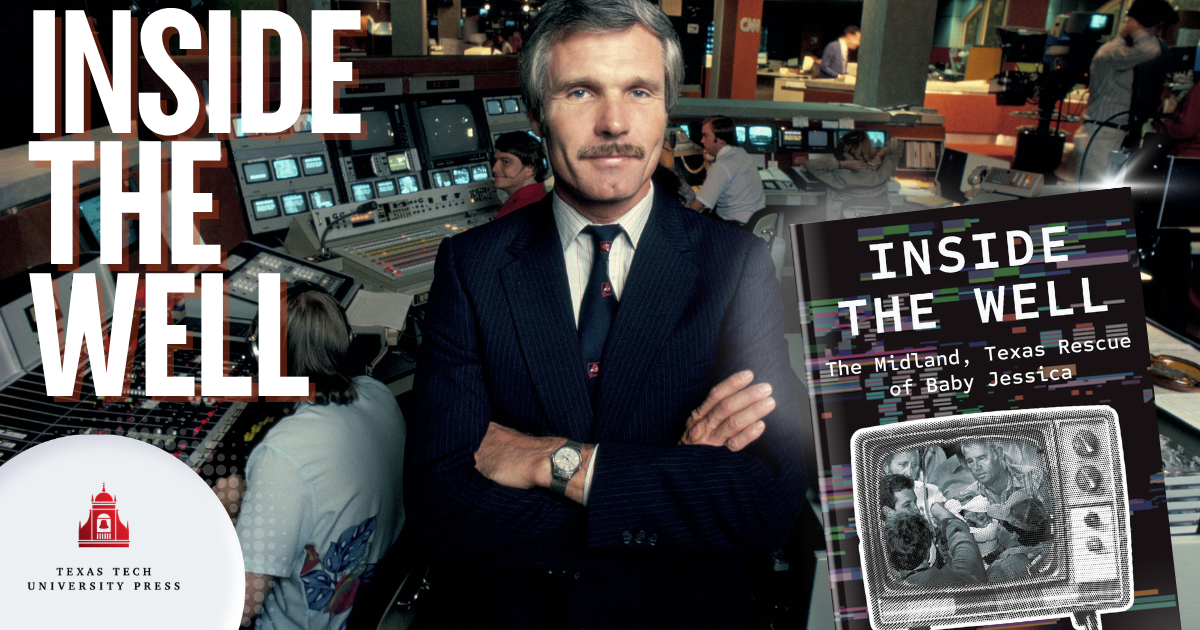
The death of media pioneer Ted Turner prompted a brief reflection on one of the defining moments in the history of cable news: The 1987 rescue of Jessica McClure from an abandoned water well in Midland, Texas. What began as a local incident became a global media event with the potential to blossom into a national tragedy with the eyes of the world fixated on West Texas. In many ways, it helped cement the legitimacy and future of 24-hour cable news.
In my book, Inside the Well, I documented not only the dramatic rescue itself, but also the unprecedented media response surrounding it. I chose to explore that aspect in detail because the story of the rescue cannot fully be told without understanding how millions of people experienced it in real time through television — particularly through CNN.
At the time, CNN was still proving itself against the dominance of traditional network news. Turner’s vision of continuous live coverage was often mocked by critics who questioned whether audiences would watch breaking news unfold hour after hour. But the rescue of Jessica McClure demonstrated something revolutionary: Viewers would stay emotionally invested when cameras remained fixed on a developing human drama.
Turner built a newsroom culture willing to commit extraordinary resources to major events. It was a sense of principle for the committed journalism teams Turner inspired. Rarely examined, however, was how Turner’s financial model enabled the news team to work outside of the pressures and forces of a business development team. Among CNN’s traditional competitors at the major networks (ABC, CBS, and NBC), these sales teams still had a stranglehold on their respective organizations, forcing strict adherence to running commercials based on sold and committed ad inventory. CNN didn’t have the same pressure. Turner knew his team could stay with local coverage while the competitors had to cut to commercials.
CNN’s teams stayed on the ground in Midland around the clock, keeping cameras pointed at the exhausted rescuers, the tense waiting family, the press briefings, and the emotional swings that defined each hour of the operation. The network understood instinctively that the story was larger than a single news update. It was a shared national experience unfolding moment by moment. As networks cut to commercial, CNN stuck to its approach and stayed with the rescue resulting in a rise in viewers waiting for more information on the fate of the girl everyone nicknamed “Baby Jessica”.
That commitment changed television news.
The rescue became one of the first truly immersive live news events of the cable era, foreshadowing the kind of continuous coverage that would later define everything from wars to natural disasters to national tragedies. Until the tragic death of Princess Diana a decade later, it was measured as the most watched news event about a single person of all time, according to a Pew Research Center analysis. Turner’s willingness to trust the audience’s appetite for live, evolving coverage helped reshape journalism and audience expectations alike.
In researching Inside the Well, it became clear that the rescue served as both a human triumph and a pivotal media turning point. The event validated Turner’s gamble on 24-hour news and showed how live television could unite audiences around a singular emotional story. It also revealed the growing power — and responsibility — of nonstop media attention in shaping public memory.
Today, as the media industry continues to evolve in the digital age, it is difficult to overstate how transformative that moment was. Ted Turner was no only building a television network, but more importantly perhaps, was his pioneering vision to disrupt traditional broadcast media in an entirely new and repeatable way for the world to witness history together in real time.
By Lance Lunsford
May 13, 2026
Share Now>


How the book came to be | Going inside
In 2002, I was reticent at the prospect of taking

Reading Group Guide: Inside the Well
Do you have a book club or reading group? This

Texas Tech University Press Announces Publication of New Book on the Dramatic “Baby Jessica” Rescue and the Tragic Aftermath
Lubbock, TX – July 10, 2024 – Texas Tech University

SCOTUS modeling democratic reforms for congressional action
The Loper Bright case and the recent ruling from the
STAY IN THE LOOP
Subscribe to our free newsletter.
Ted Turner’s legacy and the dawn of 24-hour cable news
The death of media pioneer Ted Turner prompted a brief
How the book came to be | Going inside
In 2002, I was reticent at the prospect of taking
Reading Group Guide: Inside the Well
Do you have a book club or reading group? This
Texas Tech University Press Announces Publication of New Book on the Dramatic “Baby Jessica” Rescue and the Tragic Aftermath
Lubbock, TX – July 10, 2024 – Texas Tech University
SCOTUS modeling democratic reforms for congressional action
The Loper Bright case and the recent ruling from the